• Redaktion KW in PS
Wie funktioniert ein kW-in-PS-Rechner?
Erfahren Sie, wie moderne Online-Rechner Motorleistungen in Echtzeit fehlerfrei von Kilowatt in Pferdestärke und Horsepower umwandeln.
Artikel lesen 3 Min. Lesezeit
Der schnellste Weg, Kilowatt in Pferdestärke umzurechnen. Echtzeit-Ergebnis, keine Werbung, keine Ablenkung.
Geben Sie oben einen Wert ein
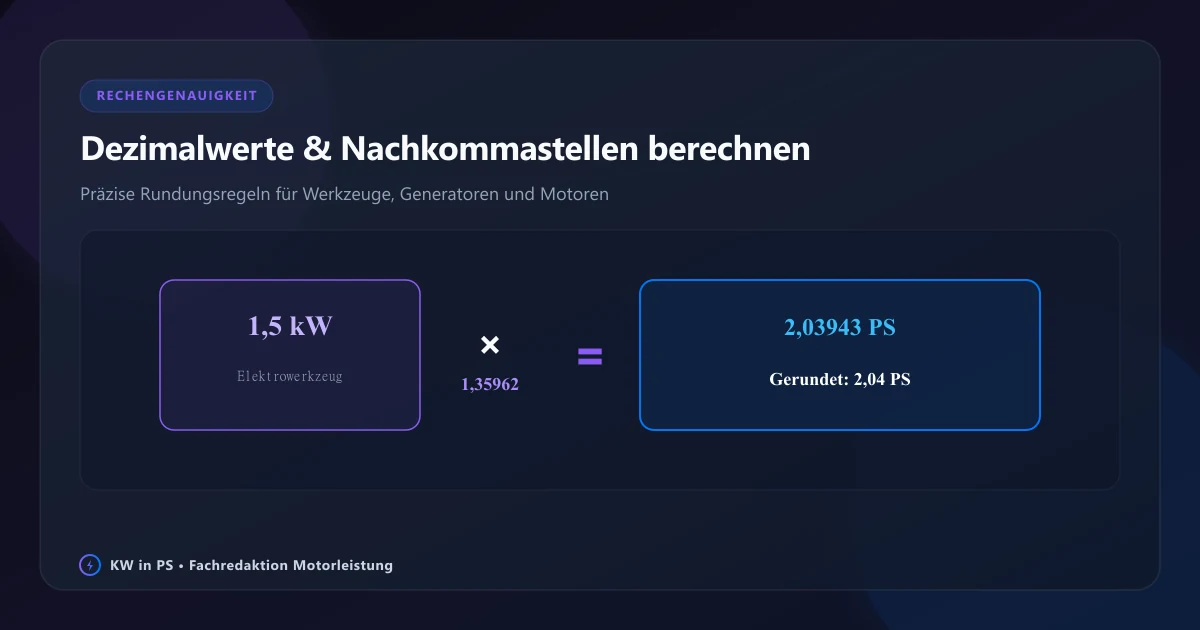
Kilowatt (kW) in Pferdestärke (PS) umzurechnen gehört zu den häufigsten Aufgaben bei der Bewertung von Motorleistung. Die Umrechnungsformel lautet: kW × 1,35962 = PS. Dieser Umrechnungsfaktor basiert auf der Definition von 1 PS als 75 Kilogramm-Kraft pro Meter pro Sekunde (75 kgf·m/s), was 735,49875 Watt (W) entspricht.
Die beiden wichtigsten Maßeinheiten für Motorleistung verständlich erklärt
Das Kilowatt (kW) ist die international genormte, gesetzliche Standardeinheit für Leistung (1 kW = 1.000 Watt). Es beschreibt die verrichtete physikalische Arbeit pro Zeiteinheit.
Die Pferdestärke (PS) ist die historisch etablierte Maßeinheit für Fahrzeugleistung. 1 PS ist physikalisch definiert als die Kraft, die benötigt wird, um 75 Kilogramm in 1 Sekunde um 1 Meter anzuheben.
Die kW-zu-PS-Umrechnung in 3 einfachen Schritten
Den kW-Wert des Motors aus dem Fahrzeugschein (Feld P.2), dem Datenblatt oder der Betriebsanleitung ablesen.
Den abgelesenen kW-Wert mit dem Umrechnungsfaktor 1,35962 multiplizieren. Die Formel lautet: PS = kW × 1,35962.
Das Ergebnis ist die Motorleistung in Pferdestärke (PS). Ein Motor mit 100 kW hat 100 × 1,35962 = 135,96 PS.
Ein Elektromotor mit 150 kW leistet 150 × 1,35962 = 203,94 PS. Ein Verbrennungsmotor mit 85 kW hat 85 × 1,35962 = 115,57 PS. Die gleiche Formel gilt für jeden Motortyp – ob Verbrenner, Elektro oder Hybrid.
Formel und Gegenrichtung auf einen Blick
PS aus einer kW-Angabe zu berechnen erfordert einen einzigen Rechenschritt: den kW-Wert mit 1,35962 multiplizieren. Für die Gegenrichtung (PS zu kW) wird der PS-Wert mit 0,73550 multipliziert.
3 häufig gesuchte Berechnungen: 75 kW × 1,35962 = 101,97 PS. 110 kW × 1,35962 = 149,56 PS. 200 kW × 1,35962 = 271,92 PS.
Woher der Faktor 1,35962 stammt und wie Leistungseinheiten zusammenhängen
Klicken Sie auf eine Zeile, um den Wert direkt in den Rechner zu laden
| kW (Kilowatt) | PS (Metric HP) | HP (Mechanical) |
|---|---|---|
| 25 kW | 33.99 PS | 33.53 hp |
| 40 kW | 54.38 PS | 53.64 hp |
| 50 kW | 67.98 PS | 67.05 hp |
| 60 kW | 81.58 PS | 80.46 hp |
| 70 kW | 95.17 PS | 93.87 hp |
| 75 kW | 101.97 PS | 100.58 hp |
| 80 kW | 108.77 PS | 107.28 hp |
| 90 kW | 122.37 PS | 120.69 hp |
| 100 kW | 135.96 PS | 134.10 hp |
| 110 kW | 149.56 PS | 147.51 hp |
| 120 kW | 163.15 PS | 160.92 hp |
| 130 kW | 176.75 PS | 174.33 hp |
| 140 kW | 190.35 PS | 187.74 hp |
| 150 kW | 203.94 PS | 201.15 hp |
| 175 kW | 237.93 PS | 234.68 hp |
| 200 kW | 271.92 PS | 268.20 hp |
| 225 kW | 305.91 PS | 301.73 hp |
| 250 kW | 339.91 PS | 335.26 hp |
| 300 kW | 407.89 PS | 402.31 hp |
| 350 kW | 475.87 PS | 469.36 hp |
| 400 kW | 543.85 PS | 536.41 hp |
| 500 kW | 679.81 PS | 670.51 hp |
12 gängige kW-Werte und die zugehörigen PS-Ergebnisse (anklicken zum Berechnen)
Dezimalwerte wie 0,29 kW (0,39 PS), 0,3 kW (0,41 PS) oder 0,5 kW (0,68 PS) lassen sich mit der gleichen Formel umrechnen. Die Formel PS = kW × 1,35962 funktioniert für alle positiven kW-Werte, egal ob ganzzahlig oder dezimal. Weitere Werte: 103 kW = 140,04 PS, 132 kW = 179,47 PS, 140 kW = 190,35 PS, 230 kW = 312,71 PS.
Leistungsgewicht berechnen und Motorleistung präzise einordnen
Das Leistungsgewicht gibt Auskunft über die Fahrdynamik eines Fahrzeugs. Formel: Leistungsgewicht = Motorleistung (PS) ÷ Fahrzeuggewicht (kg) × 1.000.
Die Motorleistung wird am Dynamometer gemessen. Der dort ermittelte Wert heißt Brake Horsepower (BHP) und kann vom Nennwert um 5–15 % abweichen.
Ein Elektromotor gibt die Nennleistung in kW sofort ab, während ein Verbrennungsmotor die Nennleistung erst bei einer bestimmten Drehzahl (RPM) erreicht.
Spezialisierte Rechner für Autos, Motorräder und die Rückrechnung von PS in kW
11 präzise Antworten zur kW-PS-Umrechnung
Artikel zu Motorenleistung, Elektroauto-Kilowatt und Tuning-Themen.
Erfahren Sie, wie moderne Online-Rechner Motorleistungen in Echtzeit fehlerfrei von Kilowatt in Pferdestärke und Horsepower umwandeln.
Zulassungsbescheinigung Teil I richtig lesen: Wo die Motorleistung im Feld P.2 eingetragen ist und wie Sie typische Ablesefehler vermeiden.
So rechnen Sie Kommazahlen und unrunde Kilowatt-Angaben präzise in Pferdestärke um ohne kumulierende Rundungsfehler.